


Since June 2025, a household on Pepco’s grid in Washington DC pays $20.81 more a month for electricity, a 17.7% jump. Nothing on the bill mentions AI.
The price was set at an auction held a year before the first higher bill arrived, and the biggest new buyer shaping that auction was the data centre industry. Who pays for AI’s electricity is being decided like this, years in advance, before anyone notices. The bill is where the decision lands.
Here is where the $20.81 comes from.
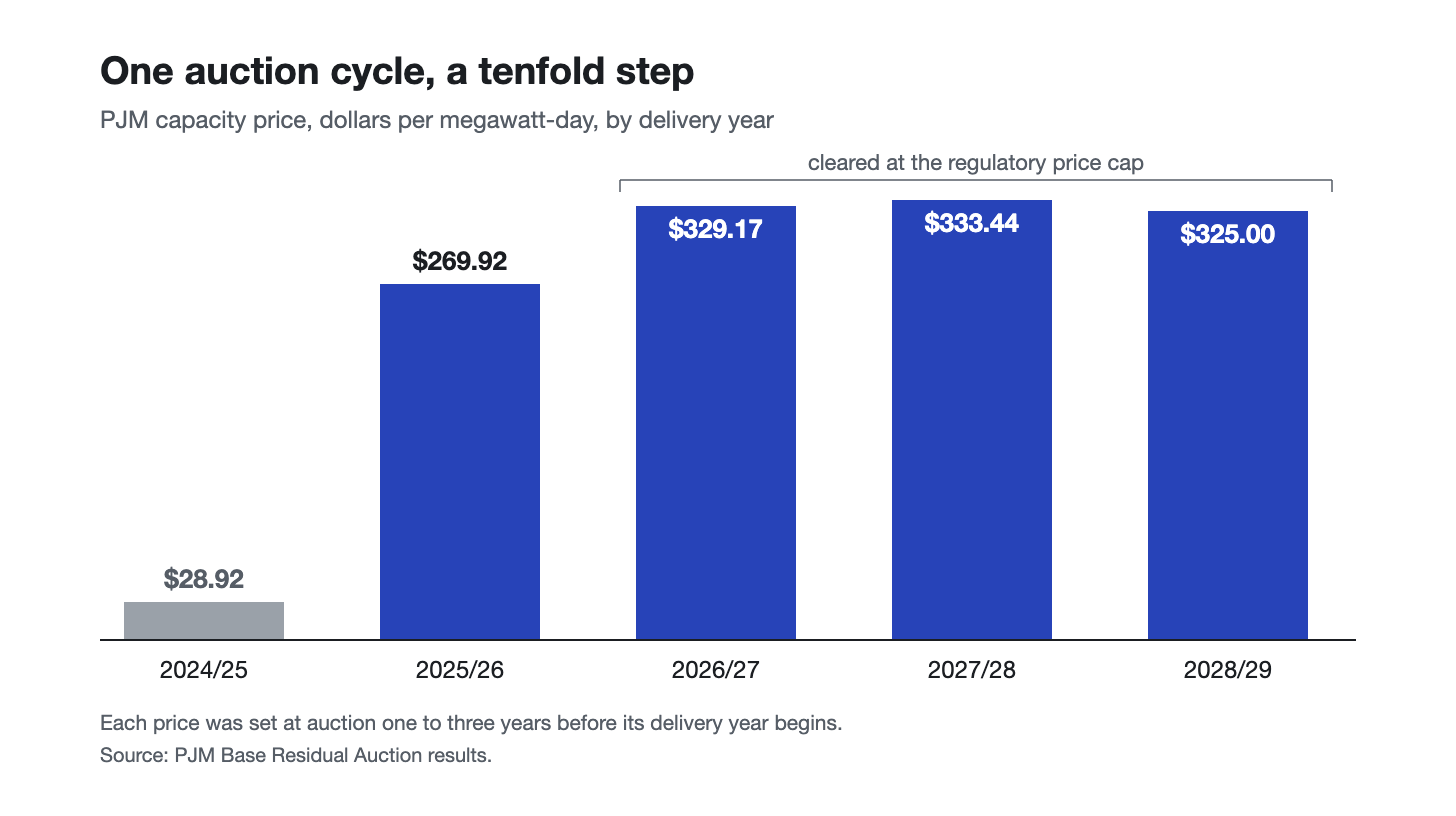
PJM’s independent market monitor, Monitoring Analytics, attributes 63% of the 2025/26 price jump to data centres. In money, $9.3 billion of added capacity costs in a single year, recovered from everyone’s bills. Rutgers’ policy lab, which went looking for a data-centre effect in residential bills through 2024, answered in their own words, “mostly not. Yet.” The prices already locked into cleared auctions are the yet.
This design makes households the involuntary counterparty of the buildout’s demand bet. Capacity is bought up to three years ahead, on projected demand, and the money flows mostly to power plants that already exist, paid to be available. If the projections are wrong, if the AI demand behind them never materialises, the money has already been collected, and no mechanism sends it back.
And it is early. Data centres take roughly 4.5% of US electricity today, by the Department of Energy’s count, and Goldman Sachs projects US data-centre capacity more than doubling between the end of 2025 and the end of 2027. The people building it say the binding constraint on the buildout is now power. There is even a receipt for what powered capacity is worth to them: in July, Anthropic signed a 20-year lease on TeraWulf’s 400-megawatt data-centre campus in Kentucky, around $19 billion of contracted revenue for a single site. A company that commits $19 billion to one site for twenty years can reasonably be asked to cover the cost of the demand it brings.
Ireland shows where the road goes, and it also found something better than a dead end.
In 2025, data centres consumed 23% of Ireland’s metered electricity, nearly as much as every household in the country combined, which uses 28%. Irish households pay the highest electricity prices in the EU, €0.4042 per kilowatt-hour including taxes in late 2025, about 40% above the EU average. The prices have several causes, an island grid, a heavy dependence on imported gas, network costs, and nobody has shown the data centres set them; what the numbers do show is scale colliding with a small grid.
New data-centre connections around Dublin had been frozen since 2021. When the regulator, the CRU, ended the freeze in December 2025, it attached one condition. A data centre may now connect only if it brings its own generation or storage, sized to 100% of its demand. Ireland has not solved this; its households still pay the most in Europe. What it found is the principle. The buildout pays its own way, or it does not connect.
That principle is travelling. In the US it already exists as practice, hyperscalers building, bringing or buying generation for their largest sites, some of it behind their own meters. In March 2026 it became policy language: seven companies, among them Amazon, Google, Meta, Microsoft and OpenAI, signed the White House’s Ratepayer Protection Pledge, committing to cover their new demand with new supply and to pay their own grid-connection costs rather than passing them to households. By summer, 187 utilities and 23 US governors had joined.
The pledge is voluntary, with no enforcement mechanism, which is Brookings’ entire critique of it, and PJM’s prices are locked through May 2029 either way. The principle arrived after the bills were locked. One more honest clause: bringing your own power settles who pays for new generation, not who pays for the wires, and when a grid’s biggest customers step out of the shared pool, the fixed network costs stay behind with everyone else.
In Europe, the starting point is worse. Before 2022, Russian gas made up about 40% of EU gas imports. When that ended, European governments allocated roughly €758 billion to shield households and firms, and prices never went back; European industry still pays 2 to 2.5 times US electricity prices. Onto that grid, the new demand is arriving anyway. The IEA expects European data-centre consumption to grow about 70% by 2030; Ember, more aggressive, projects 150% by 2035. The European bill is where those two lines cross, the grid that never recovered and the demand that has barely started.
Which is why the supply side matters.
What already works is unglamorous. The utility Stockholm Exergi buys waste heat from data centres and feeds it into the city’s district heating; across Finland, Sweden and Norway, data-centre heat already warms more than 100,000 homes. A cooling cost became revenue, and someone’s radiator is the beneficiary. Google has put 1 gigawatt of demand response under contract with US utilities, machines that agree to slow down when the grid is stressed. Under contract, not yet a measured gigawatt of delivered flexibility.
One step behind sits a restart. Microsoft signed a 20-year deal with Constellation to bring Three Mile Island’s Unit 1 back, 835 megawatts that shut in 2019 for economics. Fresh fuel is due by the end of 2026, restart targeted for 2027, a year ahead of plan. A proven plant with a new customer, not a new technology.
And at the frontier, Commonwealth Fusion Systems is finishing SPARC, the machine meant to demonstrate net fusion energy in 2027. Google has signed for 200 megawatts from the first commercial plant to follow, conditional on SPARC working. It pays out only if the physics does.
One weight belongs on the other side of that ladder: much of the buildout still runs on gas. Homer City, a dead Pennsylvania coal site, is being rebuilt as a 4.4 gigawatt gas plant for data centres, more capacity than five Three Mile Island restarts.
So the pieces of a better arrangement exist. Dublin’s regulator wrote the principle into a connection rule. Seven of the biggest buyers signed their names to it in Washington. The heat is already in Nordic radiators, the reactor is being brought back, the fusion plant has a customer waiting on the physics. What is scarce is time. Almost everything on that list starts delivering after 2027, the auctions through May 2029 have already cleared, and the next one will set prices for 2029/30 whether or not any of this is ready.
One open question
What I cannot work out is whether the rules and the machines move faster than the auction calendar. The pledge has no teeth yet. The fusion plant has no net watt yet. The auctions have dates.
If you can see your country’s version from where you sit, a regulator consulting on connection rules, a data-centre share statistic, a line moving on your own bill, reply and tell me what you see. I would especially like to hear from anyone whose regulator has started asking data centres to bring their own power, the way Dublin now does.
The next auction already has a date.